
📰 Supreme Court Upholds Telangana’s BC Quota Hike in Local Bodies ⚖️🌾

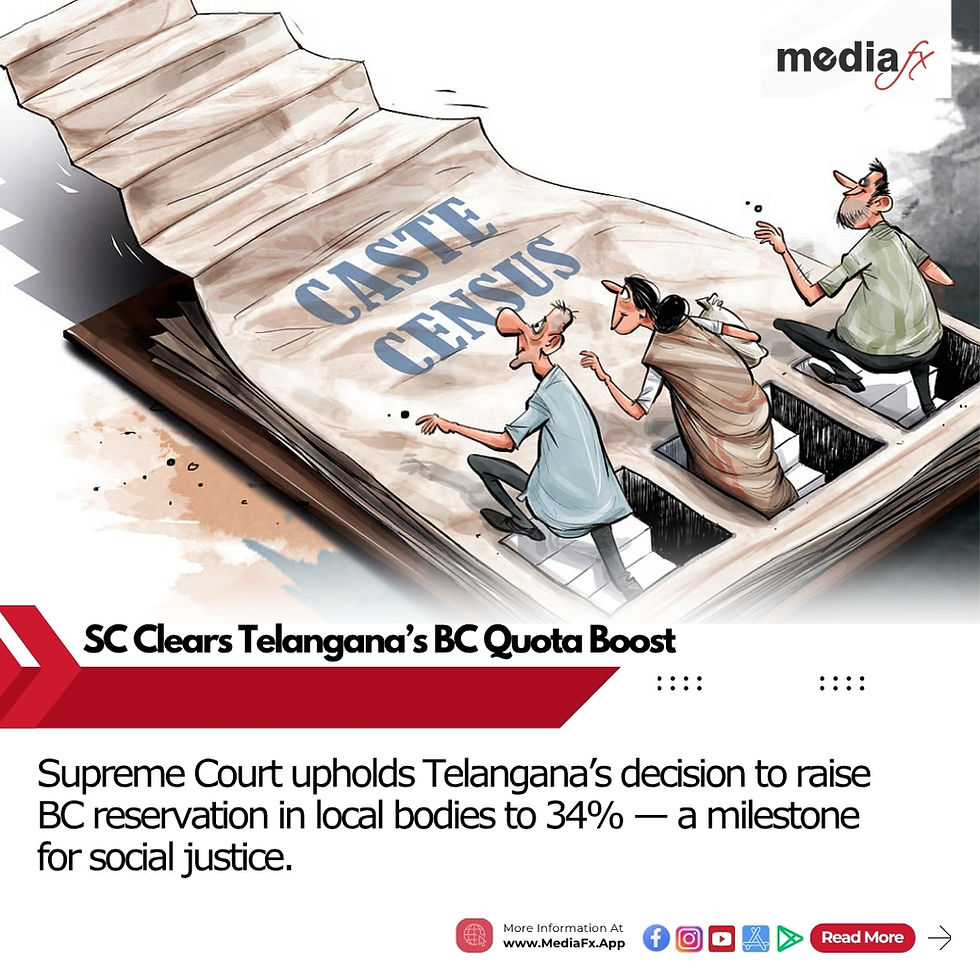
TL;DR:The Supreme Court has dismissed a petition challenging the Telangana government’s decision to enhance Backward Class (BC) reservations in local body elections — marking a big win for the state’s social justice policy. 🙌
What Happened?
The petition contested Telangana’s move to raise BC reservation from 23% to 34% in Panchayati Raj and Municipal polls.
The court ruled that the enhancement followed due constitutional process, including proper data-based justification.
The Bench observed that reservation policy lies within the state’s competence when backed by socio-economic surveys. 🏛️
Flashback / Context
The Telangana government had increased BC representation citing backward class population data from the Commission for Backward Classes report.
Petitioners argued it breached the 50% total reservation cap set by earlier Supreme Court rulings.
The court, however, clarified that local body reservations operate under separate constitutional provisions (Articles 243D and 243T).
Who Gains & Who Loses?
Gains: BC communities, especially rural groups seeking political participation. 💪
Losses: Petitioners, mostly from general-category groups, who argued for a uniform reservation ceiling.
Political Impact: Strengthens the Telangana government’s pro-BC image ahead of upcoming local elections.
People’s Angle
For ordinary voters and rural youth, this verdict means more representation in village and municipal decision-making. 🌾 It also signals judicial recognition of grassroots empowerment efforts.
MediaFx Take
This verdict reminds India that equality isn’t about limiting opportunity but expanding participation. 🕊️ Telangana’s BC quota victory could inspire other states to strengthen local democracy through inclusion, not exclusion.



Comments