
📰 Sundar Pichai Hails Google Scientists Who Won 2025 Nobel in Physics 🏆🌌

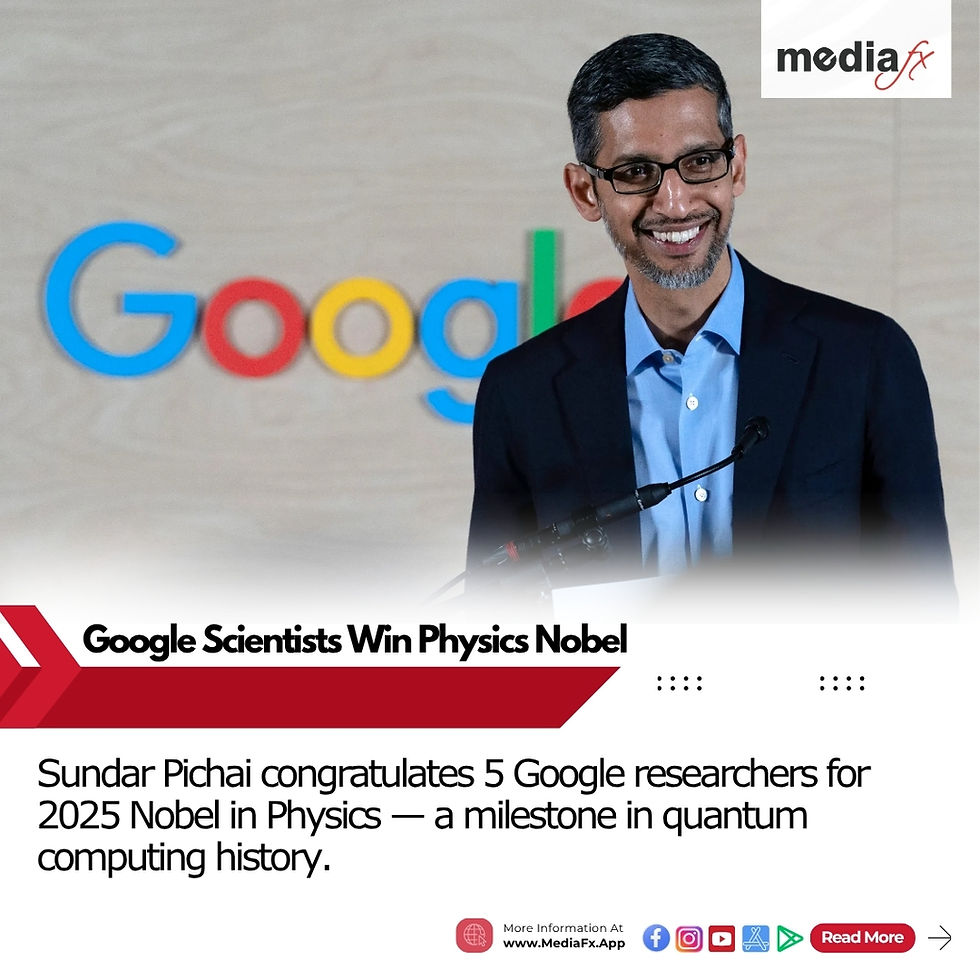
TL;DR:Five researchers from Google Quantum AI, including Michel Devoret, John Martinis, and John Clarr, have won the 2025 Nobel Prize in Physics for breakthroughs in quantum computing. 🎉 Google CEO Sundar Pichai congratulated the team, calling it “a proud moment for science and technology.”
What Happened?
The Nobel Committee recognized their pioneering work on quantum error correction — a crucial step toward building reliable quantum computers. 💻
The team’s research allowed quantum bits (qubits) to maintain stability long enough for complex calculations — a milestone once thought impossible.
Pichai shared his congratulations on X, writing that the win was “a huge leap for science and for Google’s mission to solve impossible problems with AI and quantum computing.”
Flashback / Context
Quantum computing uses the principles of quantum mechanics to process massive datasets faster than traditional computers.
Google first achieved “quantum supremacy” in 2019, when its Sycamore processor solved a computation faster than the world’s most powerful supercomputer.
The Nobel win validates years of investment in Google’s Quantum AI lab based in Santa Barbara, California.
Who Gains & Who Loses?
Gains: Google, which cements its reputation as a frontier innovator in physics and computing. 🌍
Gains: The scientific community, as the prize rekindles public excitement around fundamental research.
No Losses: Only global applause for team science! 👏
People’s Angle
For students and young techies, this win is proof that curiosity pays off. 🔬 It’s not just about coding or gadgets — it’s about pushing the boundaries of what’s possible.
MediaFx Take
When science and corporate innovation meet for the right reasons, humanity leaps forward. 🚀 Pichai’s pride echoes a global truth: technology should celebrate discovery, not just profit.


Comments