
No Green Screens, Real Seas: How Nolan Made ‘The Odyssey’

Christopher Nolan has revealed the extraordinary effort behind the making of The Odyssey, describing the mythological epic as one of the most demanding films of his career.
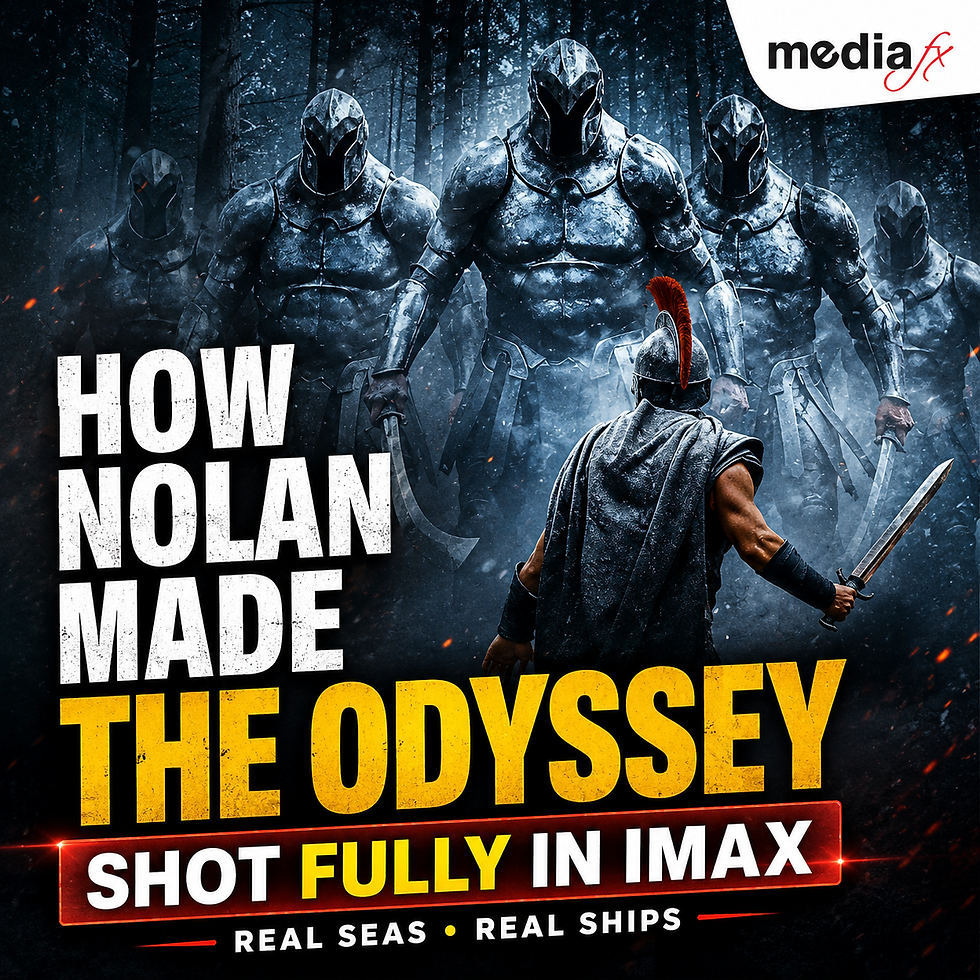
The filmmaker adapted Homer’s ancient Greek poem on a massive scale, using real locations, practical sets and full-sized vessels to recreate Odysseus’ dangerous journey home after the Trojan War. The movie has also become the first full-length feature to be shot entirely with IMAX film cameras. (The Guardian)
Filmed Across Challenging Real Locations
Instead of relying heavily on studio environments and green screens, Nolan took the cast and crew to locations across countries including Morocco, Greece, Italy, Iceland and Scotland.
The production filmed at sea, on beaches, near ancient structures and in unpredictable weather to capture the physical difficulty of travelling through an unknown world. Nolan said the scale and logistical complexity sometimes made him feel that he had taken on more than he could handle. (The Guardian)
First Film Shot Entirely on IMAX Film
Nolan and cinematographer Hoyte van Hoytema filmed the entire movie using IMAX film cameras, a significant technical achievement because the equipment is traditionally large, noisy and difficult to use during dialogue scenes.
To solve these problems, IMAX developed improvements including a noise-reducing camera enclosure and a mirror-based viewing system. A customised camera used on the production was named The Keighley, honouring late IMAX executive David Keighley. (AP News)
The large-format film is intended to deliver exceptional detail, depth and immersion when projected in IMAX 70mm theatres.
Real Ships and Practical Effects
For the maritime sequences, the filmmakers placed actors on real vessels and filmed extensively on open water.
The production also used practical sets, physical creatures and large-scale props wherever possible. Reports indicate that the film relied on a combination of animatronics, puppetry and selective digital effects rather than creating its mythological world entirely through CGI. (Vanity Fair)
Matt Damon, who plays Odysseus, revealed that the cast and filmmakers even climbed inside a constructed Trojan Horse to determine how the complicated sequence should be filmed. He described Nolan’s process as unusually hands-on and collaborative despite the project’s enormous scale. (People.com)
A Massive 91-Day Production
Principal photography reportedly lasted around 91 days, with filming completed ahead of schedule.
The production used an enormous quantity of 70mm IMAX film and moved between remote landscapes, coastal areas and historic locations. The scale of the shoot made it one of Nolan’s most ambitious productions following the global success of Oppenheimer. (Vanity Fair)
Star-Studded Cast
The film stars Matt Damon as Odysseus, with Anne Hathaway playing Penelope.
The ensemble cast also includes:
Tom Holland
Zendaya
Robert Pattinson
Lupita Nyong’o
Charlize Theron
Jon Bernthal
John Leguizamo
The story follows Odysseus as he faces war, storms, monsters and supernatural dangers while attempting to return home to his family.
Nolan’s Biggest Creative Risk
Produced with a reported budget of approximately $250 million, The Odyssey became possible after the extraordinary commercial and awards success of Oppenheimer.
Nolan said the project demanded physical endurance, complicated coordination and a willingness to embrace uncertainty. His goal was to make the ancient legend feel immediate, human and physically real rather than distant or purely fantastical. (The Guardian)


Comments